
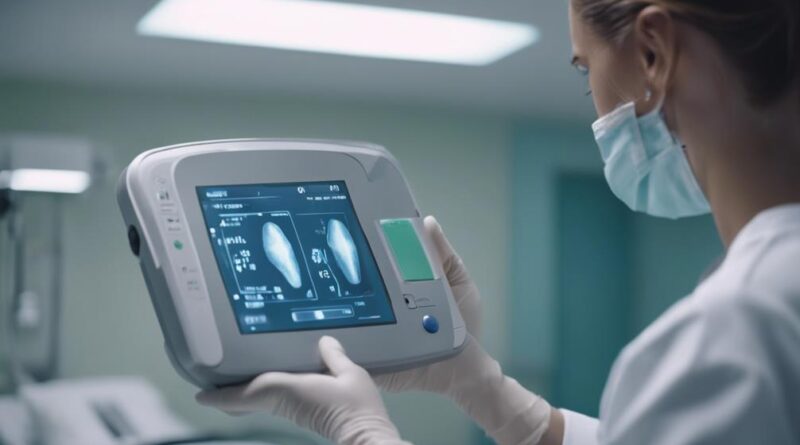
How Is AI Used in Bladder Scanning Technology?
You've probably heard about AI's impact in various medical fields, but have you considered its role in bladder scanning technology? By integrating AI, devices like the BladderScan i10 offer precise measurements and real-time imaging, greatly enhancing diagnostic accuracy and patient care. This technology not only streamlines the process but also plays an essential role in preventing complications such as catheter-associated urinary tract infections. With AI-driven advancements, the implications for patient management and healthcare efficiency are vast. Now, consider how these innovations could further evolve to meet the challenges of modern healthcare demands. What might the future hold for AI in this area?
Key Takeaways
- AI-powered bladder scanners like BladderScan i10 use ImageSense™ technology to accurately pinpoint bladder location for precise volume measurements.
- Automated aiming assists in bladder scanners simplify the scanning process, ensuring accurate results regardless of the operator's expertise level.
- Real-time bladder auto-location technology in AI scanners minimizes the need for invasive procedures, reducing the risk of catheter-associated infections.
- AI-driven diagnostics in bladder scanning enhance early detection of urinary retention, improving patient care and reducing unnecessary catheterizations.
- AI technology in bladder scanners adapts to various patient anatomies, providing tailored and efficient scanning experiences for both adults and children.
Overview of BladderTraq Technology
BladderTraq Technology revolutionizes the way clinicians perform bladder scans by automatically locating the bladder in real-time, guaranteeing precise measurements. This advanced AI technology not only streamlines the ultrasound process but also heightens diagnostic accuracy, essential for ideal patient care.
You'll find that each scan becomes more reliable, reducing the guesswork and variability often associated with manual methods.
The technology features a live B-mode display, enabling you to aim precisely before each scan. This guarantees that the bladder volume measurements you obtain are accurate, which is vital in avoiding unnecessary catheterizations. Such precision plays a notable role in mitigating risks linked to catheter-associated urinary tract infections.
It's a game-changer in how healthcare providers manage bladder assessments, offering a non-invasive solution that prioritizes patient safety and comfort.
Moreover, the onscreen highlighting feature visually identifies the bladder, simplifying the scanning process. This enhancement supports you in making informed decisions quickly, improving clinical workflows considerably.
As you integrate BladderTraq into your practice, you'll notice a shift towards more efficient, precise, and patient-focused care, notably impacting how urinary health is managed in medical settings.
Impact on CAUTI Prevention
Nearly 80% of hospital-acquired urinary tract infections are linked to the use of urinary catheters, emphasizing the vital need for effective prevention strategies.
You mightn't realize it, but AI-powered bladder scanning technology, like the BladderScan i10, is revolutionizing how these infections are prevented. By accurately measuring bladder volume, this technology greatly cuts down on unnecessary catheterizations, which are a prime source of catheter-associated urinary tract infections (CAUTI).
Imagine reducing the dependency on catheters—this isn't just about comfort; it's an essential step in slashing the rates of infections. AI enhances the precision in detecting post-operative urinary retention. This early detection is key in preventing CAUTI, ensuring that catheters are used only when absolutely necessary.
You're not only safeguarding the patient's health but also contributing to considerable healthcare savings.
Think about it: facilities using the BladderScan can save over $150,000 annually. These savings stem from reduced catheter use and lowering infection rates. With the average cost of treating an ICU UTI around $8,700, the financial benefits are clear.
You're at the forefront of a shift that promises both medical and economic relief, thanks to AI in bladder scanning.
Accuracy Features in Bladderscan I10

Often, the effectiveness of medical devices hinges on their precision, and the BladderScan i10 sets a high benchmark in this regard. With the integration of cutting-edge AI technology, you're looking at exceptional accuracy in bladder volume measurements, vital for effective patient care.
Let's explore some key features that make the BladderScan i10 a standout in the medical field:
- Real-time Auto-location: The BladderTraq feature enhances accuracy by pinpointing the bladder's location as you scan, guaranteeing measurements are precise and reliable.
- ImageSense™ AI Technology: This advanced technology offers an accuracy rate of ±7.5% for bladder volumes over 100 mL. You can trust the data you're seeing.
- Automated Aiming Assist: Simplifies the scanning process regardless of your expertise level, making it easier to get accurate results without the fuss.
- Adaptable to Various Patient Anatomies: Whether it's an adult or a child, the BladderScan i10 adjusts its approach to suit different body types, guaranteeing everyone gets a tailored and accurate scanning experience.
These features collectively guarantee that the BladderScan i10 isn't just automated but adapts smartly to real-world challenges in patient care.
Workflow Enhancements With AI
With the help of ImageSense™ AI technology, the BladderScan i10 streamlines your workflow by speeding up bladder volume assessments and enhancing accuracy.
This integration of AI notably simplifies your clinical practice, allowing for faster decision-making in real time. You'll notice that the automated aiming assist and the point-and-click 3D scanning probe make the whole process more intuitive. There's no need for complex maneuvers anymore, which cuts down the time you spend on each patient.
These improvements aren't just about speed. The AI also boosts the precision of bladder volume measurements, providing you with confidence in your assessments.
This heightened accuracy is essential for early detection of post-operative urinary retention, directly impacting patient care by reducing unnecessary catheterizations. Consequently, this minimization helps lower the risk of catheter-associated urinary tract infections, enhancing patient outcomes.
Examination of Related Products

Exploring related products, you'll find that the BladderScan i10™ and Clarius Bladder AI are both at the forefront of non-invasive bladder scanning technology. These cutting-edge tools leverage AI to revolutionize how medical professionals handle bladder assessments while enhancing patient care.
Here's how AI is shaping the landscape:
- BladderScan i10™: Utilizes BladderTraq technology to automatically locate the bladder, greatly improving the accuracy of bladder volume measurements. This precision minimizes unnecessary catheterizations, thereby reducing the risk of infections in the urinary tract.
- ImageSense™ AI: Powers both BladderScan i10™ and BladderScan® Prime Plus™, maintaining a ±7.5% accuracy rate for volumes over 100 mL. This high level of accuracy guarantees dependable results across varied medical settings.
- Clarius Bladder AI: Integrates with multiple Clarius ultrasound scanners, providing a versatile tool for acute care and urology. Its AI-driven volume measurement helps quickly decide patient care paths without the need for invasive procedures.
- Economic Impact: The BladderScan ROI calculator demonstrates considerable cost savings in healthcare facilities by reducing unnecessary catheterizations and associated medical costs.
These advancements in bladder scanning and medical imaging underscore the powerful role AI plays in enhancing healthcare efficiency and patient safety.
AI in Urinary Health Management
As you explore the integration of AI in urinary health management, you'll find that AI-driven diagnostic support not only enhances the accuracy of diagnoses but also personalizes treatment for various urinary conditions.
Technologies like the BladderScan i10, equipped with ImageSense™, exemplify how precision in bladder volume measurements can greatly impact clinical outcomes. This shift towards AI-supported tools minimizes invasive procedures, such as catheterizations, thereby reducing infection rates and associated healthcare costs.
AI-Driven Diagnostic Support
AI technologies are revolutionizing the way we manage urinary health, offering precise and consistent bladder volume measurements that enhance diagnostic accuracy. With the implementation of AI, like ImageSense™ in BladderScan devices, you're seeing a transformative shift in how bladder ultrasounds are conducted.
Here's how AI is making a considerable impact:
- Real-time bladder auto-location: Advanced AI algorithms improve scan precision, quickly identifying the bladder and considerably reducing unnecessary catheterizations that risk catheter-associated urinary tract infections (CAUTI).
- Automated aiming assists: AI integration streamlines clinician workflows, allowing for quicker, more efficient assessments in various clinical settings, guaranteeing you get accurate results without delay.
- Enhanced diagnostic capabilities: Ongoing research in AI-driven technologies supports early detection of urinary retention, improving patient care outcomes by catching issues before they escalate.
- Cost savings: AI applications in bladder scanning are projected to save over $150,000 for 100-bed facilities by cutting down on invasive procedures.
These advancements in machine learning not only bolster diagnostic capabilities but also guarantee that you're getting safer, more effective urinary tract management without the added risk of invasive catheterizations.
AI is setting a new standard in healthcare, prioritizing both efficiency and patient safety.
Personalized Healthcare Enhancement
Harnessing the power of AI, personalized healthcare in urinary management is transforming patient outcomes considerably. With AI-driven bladder scanning tools like Clarius Bladder AI and ImageSense™ in BladderScan devices, you're seeing a revolution in how urinary health is managed. These tools provide real-time feedback and precise bladder volume measurements, considerably boosting diagnostic accuracy and reducing the need for invasive procedures.
AI's role extends beyond just measurement. By analyzing extensive datasets, AI enhances the predictive capabilities of urinary health monitoring systems, allowing for early intervention and truly personalized healthcare strategies. This not only improves your health outcomes but also makes the entire healthcare delivery more cost-effective.
Here's how AI is reshaping urinary health management:
| Feature | Benefit | Impact on Healthcare |
|---|---|---|
| Real-time Feedback | Enhances decision-making accuracy | Streamlines clinical workflows |
| Predictive Capabilities | Facilitates early intervention | Improves patient outcomes |
| Personalized Treatment | Tailors interventions to individual needs | Enhances quality of life |
| Diagnostic Accuracy | Reduces unnecessary procedures | Lowers healthcare costs |
AI in bladder scanning is not just a technological advancement; it's a personal healthcare revolution, ensuring you receive care that's tailored just for you.
Innovations in Smart Toilet Tech

As you explore the latest in smart toilet technology, you'll find features like TOTO Ltd's Wellness Toilet, which uses odor sensors to spot health issues early by analyzing waste.
Meanwhile, Panasonic's smart toilet not only tracks body fat but also collects urine, offering a deeper look into your health metrics.
These innovations integrate health monitoring seamlessly into your daily routine, making preventive health management more accessible than ever.
Smart Toilet Features
Imagine having a toilet that not only manages basic sanitation but also enhances your health through high-tech features.
These smart toilets are at the forefront of integrating artificial intelligence (AI) to revolutionize how you monitor your health right from the comfort of your bathroom.
Here's a glimpse into some of the pioneering features that are setting new standards in personal healthcare:
- Odor Analysis and Urination Patterns: Tools like TOTO Ltd's Wellness Toilet use advanced sensors to analyze odors and track urination patterns, providing insights into your health status.
- Urine Collection and Body Fat Tracking: Panasonic's innovation doesn't stop at urine collection; it also measures body fat, offering a more thorough overview of your health.
- Biomarker Monitoring: The smart toilet seat by Geometry Healthcare evaluates around 30 different biomarkers through biochips, enhancing your health diagnostics considerably.
- Data Logging and Pattern Analysis: With applications like Toilet Tracker, you can log urinary and defecation data to help spot health trends and manage conditions effectively.
These smart toilets not only cater to basic needs but also empower you with critical health monitoring and bladder scanning capabilities, ushering in a new era of bathroom diagnostics.
Health Monitoring Integration
Smart toilets like TOTO Ltd's Wellness Toilet are transforming your bathroom into a hub for health monitoring by utilizing cutting-edge technology to analyze waste. These devices, equipped with odor sensors, assess your urination and defecation, pinpointing potential health issues through the detection of various biomarkers.
You're not just flushing away waste; you're providing critical data that could lead to early diagnosis and treatment of urinary diseases.
Imagine sitting on a toilet seat from Geometry Healthcare that doesn't just support you, but also scans approximately 30 biomarkers using biochips and sophisticated algorithms. This isn't science fiction; it's your new reality for thorough health tracking right at home.
Coupled with the Toilet Tracker app, you're now able to log and analyze your urination patterns, turning everyday routines into opportunities for personal health management.
Furthermore, Panasonic's innovation doesn't stop at smart toilets—it extends to urine collection and body fat tracking. Each visit to your bathroom becomes a mini health check-up.
These advancements, powered by artificial intelligence, are setting the stage for a future where bladder scanners and smart toilets work seamlessly to keep you healthy, leveraging every bathroom break as a chance for health monitoring and insight.
Diagnosing Urinary Diseases With AI
Harnessing AI in bladder scanning notably boosts the accuracy of diagnosing urinary diseases such as prostatic hyperplasia and urinary tract infections. By integrating technologies like ImageSense™ AI into devices such as the BladderScan i10, you're not just getting a gadget; you're empowering your medical practice with precision.
This leap in diagnostic accuracy is vital for timely and effective treatment.
AI's role in bladder scanning offers several clear advantages:
- Improved Diagnostic Precision: Advanced image analysis enhances the clarity and reliability of bladder scans, reducing diagnostic errors.
- Noninvasive Procedures: AI-driven ultrasonography minimizes the need for invasive catheterization, thereby lowering the risk of catheter-associated infections.
- Consistent Volume Measurements: AI algorithms guarantee that bladder volume measurements are accurate within ±7.5% for volumes over 100 mL, providing dependable data for clinical decision-making.
- Reproducibility: High inter- and intra-observer reproducibility, thanks to AI, guarantees that measurements are consistent regardless of the operator, making it ideal for various clinical settings.
You'll find that AI not only simplifies the workflow for healthcare providers but also greatly enhances the care patients receive by guaranteeing high accuracy and reducing the risks associated with traditional diagnostic methods.
Challenges in AI Implementation

While AI markedly enhances bladder scanning technologies, implementing these advancements comes with its own set of challenges. You'll find that verification is a major hurdle. Each AI application must receive medical device certification from regulatory bodies like the U.S. FDA. This guarantees the technology's safety and efficacy before it can be used widely, but it's a time-consuming and often complex process.
Moreover, gaining institutional investment is vital for bringing AI bladder scanners to market. It goes beyond funding for research and development; substantial backing is needed right through to the commercialization phase.
You also need to reflect on ethical issues. Compliance with institutional review board standards must be met to get research approval and manage potential conflicts of interest. This can be tricky to navigate.
In clinical practice, continuous assessment of these AI technologies is required. It's imperative to refine algorithms for accurate disease recognition and keep the technology relevant.
Additionally, integrating AI into existing clinical workflows presents its own challenges. You'll need user-friendly interfaces and must provide training for medical personnel, especially those with less experience in using such advanced technologies. This guarantees that everyone can use the tech effectively and safely.
Frequently Asked Questions
What Are the Applications of Artificial Intelligence in Urology?
In urology, you'll see AI transforming patient care through robotic surgery, enhancing precision and recovery times.
It's essential in patient monitoring, using predictive analytics to foresee complications.
AI aids in treatment planning and data analysis, improving decision-making accuracy.
Risk assessment becomes more nuanced, making personalized medicine in urology more effective.
This technology tailors treatments to individual genetic profiles, greatly boosting treatment outcomes and patient satisfaction in the long run.
How Is AI Used in Ultrasound?
In ultrasound technology, you'll find that AI algorithms greatly enhance imaging precision, improving both diagnostic accuracy and patient safety.
These advanced systems assist in data interpretation, ensuring that the images you rely on are clear and precise.
AI also boosts workflow efficiency, streamlining processes for quicker, more effective results.
This integration not only saves time but also enhances the overall reliability of the diagnostic procedures you depend on.
How Is AI Used in Diagnostic Imaging?
In diagnostic imaging, you'll find AI algorithms revolutionizing the field. They enhance image analysis, streamline data interpretation, and improve pattern recognition.
This leads to accurate predictive modeling and workflow optimization. AI's role extends to supporting clinical decision-making, enabling faster and more precise diagnoses.
By integrating these advanced technologies, healthcare professionals can deliver better care, ensuring they catch issues early and tailor treatments effectively based on thorough, AI-enhanced insights.
AI really is transforming how diagnoses are approached.
How Does a Bladder Scanner Work?
A bladder scanner leverages ultrasound imaging techniques to non-invasively measure your bladder volume, enhancing patient comfort and reducing healthcare costs.
This technology uses a probe that transmits ultrasound waves to create images of your bladder, calculating the volume efficiently.
Technological advancements have refined these devices, making them integral in preventing unnecessary catheterizations and associated risks.
It's a straightforward, painless procedure that quickly assesses bladder health, streamlining diagnostic processes in medical settings.
Conclusion
You've seen how AI is reshaping bladder scanning with the BladderScan i10 and its real-time, accurate assessments. It's not just about cutting costs—it's about safer, smarter healthcare. From reducing CAUTIs to refining workflows, AI's role is essential. Beyond just scanning, AI's expanding into smart toilets and disease diagnosis, pushing the boundaries of urinary health. However, remember, integrating AI comes with challenges that need careful handling to truly harness its potential in medical technology.
