

What Is a Portable Ultrasound Scanner Used For?
Have you ever wondered how a device small enough to fit in a doctor's bag can drastically transform patient care, especially in non-traditional settings? A portable ultrasound scanner, a compact version of the traditional ultrasound machine, offers real-time imaging capabilities that are crucial in today's fast-paced medical environments. Whether it's in an emergency room, a remote clinic, or during a field operation, the ability to perform diagnostic procedures on the spot can be a game-changer. The question then becomes, how are these devices influencing modern medicine and what does this mean for the future of healthcare? Let's explore their pivotal role and emerging significance in various medical scenarios.
Key Takeaways
- Portable ultrasound scanners facilitate real-time imaging for immediate diagnostic assessments in clinical settings.
- They are used for monitoring fetal development and assessing pregnancy health.
- These devices support Point of Care Ultrasound (PoC-US) for bedside diagnostics, enhancing patient care through quick decision-making.
- They are crucial for trauma evaluations in emergency situations, providing on-the-spot internal injury assessments.
- Portable ultrasound scanners enable remote clinical diagnostics and telemedicine in isolated or disaster-affected areas.
Defining Portable Ultrasound Scanners
Portable ultrasound scanners are compact devices that provide real-time imaging vital for immediate diagnostics in various medical environments. As a healthcare professional, you'll find these portable ultrasound machines invaluable, especially when you're conducting ultrasound-guided procedures right at the point of care.
They offer non-invasive imaging solutions, which means you can diagnose and manage patients without the need for more invasive diagnostic methods.
With advanced imaging techniques like B-mode and color-flow Doppler, these tools allow you to observe and assess conditions efficiently, guaranteeing that patient care is both timely and effective. This is essential in settings where quick decision-making impacts outcomes, such as in emergency rooms or during critical care.
Moreover, the portability of these devices guarantees that you can deliver high-quality healthcare across various locations, from a hospital ward to remote clinics.
Their lower cost compared to traditional machines, combined with high functionality, makes them a smart choice for any medical practice looking to enhance service delivery without compromising on quality.
Diagnostic Applications
As you explore the diagnostic applications of portable ultrasound scanners, you'll see their significant clinical utility.
These devices offer the advantage of real-time imaging, allowing you to monitor pregnancies, assess organs, and evaluate vascular health on the spot.
This capability is particularly essential in emergency settings where quick decision-making impacts patient outcomes.
Clinical Utility Overview
One can quickly appreciate the versatility of portable ultrasound scanners when considering their broad spectrum of diagnostic applications. In emergency medicine, these devices are indispensable. You'll find them essential for the rapid assessment of trauma patients, where they help diagnose conditions like internal bleeding or organ damage quickly and efficiently. This immediate insight is possible because portable ultrasound supports Point of Care Ultrasound (PoC-US), enhancing clinical utility through real-time imaging right at the bedside.
The impact extends beyond emergency scenarios. In obstetrics, portable ultrasound proves necessary for monitoring fetal development. Its integration into routine care has greatly increased antenatal attendance and facility delivery rates, demonstrating its role in improving maternal and fetal outcomes.
Additionally, in areas like vascular medicine, portable ultrasound facilitates quick evaluations of conditions such as deep vein thrombosis and assists in procedures like central venous catheter insertions.
Thanks to advancements in technology, including AI, the diagnostic accuracy of portable ultrasound has seen substantial improvements. It now offers high-quality imaging that rivals traditional systems, expanding its use across various specialties such as cardiology and gynecology. This broad utility underscores its essential role in modern healthcare.
Real-Time Imaging Benefits
The real-time imaging capabilities of portable ultrasound scanners transform the way you can manage patient care, especially in critical settings. With portable ultrasound, you're equipped to make immediate assessments, enhancing diagnostic accuracy and speeding up decision-making processes in emergency care. This technology isn't just about quick looks; it's about detailed, reliable visualizations where and when you need them the most.
Imagine performing bedside procedures with the confidence that real-time imaging provides. You see everything clearly, which not only improves safety but also patient outcomes. Here's a quick snapshot of how real-time imaging with portable ultrasound can benefit various aspects of medical care:
| Benefit | Application | Impact |
|---|---|---|
| Immediate Assessment | Critical care settings | Enhances diagnostic accuracy |
| Procedural Accuracy | Bedside procedures like catheter insertions | Increases safety |
| Streamlined Throughput | Emergency departments | Reduces wait times |
| Enhanced Antenatal Care | Routine check-ups | Improves preventive treatments |
| Advanced Diagnostics | Integration of AI tools | Boosts clinician confidence |
As you integrate these tools into your practice, you'll notice not just an improvement in patient throughput, but a significant enhancement in overall care delivery. Portable ultrasound truly brings diagnostics right to the patient's bedside, revolutionizing how you deliver healthcare.
Emergency and Field Use

In emergency and field situations, you'll find portable ultrasound scanners invaluable for rapid trauma assessment.
They enable you to quickly diagnose conditions in settings where time is essential and conventional hospital equipment is unavailable.
Additionally, these devices are vital for conducting remote clinical diagnostics, ensuring that even in isolated areas, you can provide top-tier medical analysis.
Rapid Trauma Assessment
During emergencies, portable ultrasound scanners prove indispensable for rapid trauma assessment, enabling on-the-spot evaluations of internal injuries, such as bleeding or organ damage. You'll find that these compact devices are essential in emergency care, where real-time imaging can make the difference between life and death.
They allow healthcare providers to quickly assess the situation and decide the best course of action, improving patient outcomes considerably.
The compact design of portable ultrasounds makes them ideal for use in the field, particularly in disaster response or military operations, where traditional imaging facilities are often unavailable.
Their ability to provide immediate visual insights into a patient's condition helps in making swift, informed decisions that could potentially save lives.
Studies have shown that using portable ultrasound for rapid trauma assessment can drastically reduce the time to diagnosis.
This speed is important in emergencies, as quicker diagnosis often means quicker intervention, enhancing the chances of survival.
Whether it's a car accident or a natural disaster, having a portable ultrasound on hand means you're better equipped to handle whatever comes your way, ensuring that patients receive the best possible care at the critical moment.
Remote Clinical Diagnostics
Portable ultrasound scanners revolutionize remote clinical diagnostics by providing crucial real-time imaging capabilities during emergencies and field operations. When you're faced with a critical situation, such as cardiac arrest or internal bleeding, these devices allow you to assess trauma patients quickly and accurately. This speed and precision in emergency and critical care settings can greatly enhance patient outcomes.
In field use, especially in remote or disaster-stricken areas, portable ultrasounds extend diagnostic capabilities directly to the patient's side. You can perform essential procedures, like central venous catheter insertions, with greater safety and accuracy, reducing potential complications. This tool is indispensable for healthcare providers operating outside traditional medical facilities, guaranteeing that immediate life-saving interventions are both possible and practical.
Furthermore, portable ultrasound technology is integral to telemedicine initiatives. It enables you to conduct remote consultations and diagnostics, providing real-time imaging that guarantees timely and effective treatment. Regardless of location, you can offer expert guidance and make critical decisions that could be lifesaving.
Consequently, portable ultrasounds not only support but greatly enhance the reach and effectiveness of modern medical practices in remote clinical diagnostics.
Technological Advancements
Technological advancements have greatly enhanced the capabilities of portable ultrasound scanners, integrating cutting-edge features like AI to boost diagnostic accuracy and streamline exams. You'll find that modern portable devices now come equipped with advanced imaging technologies, which not only improve the ultrasound image but also guarantee superior imaging quality. This leap in technology includes AI integration, turning real-time imaging solutions into a cornerstone of contemporary medical diagnostics.
| Feature | Impact | Emotional Appeal |
|---|---|---|
| AI Integration | Enhances accuracy | Increases trust in diagnostics |
| Superior Imaging Quality | Rivals traditional systems | Provides reassurance of thorough care |
| Wireless Functionality | Facilitates mobility | Offers comfort and ease during exams |
| Compact Design | Easy to transport | Guarantees medical care is reachable everywhere |
| Workflow Optimization | Simplifies processes | Reduces stress for healthcare providers |
These innovations in portable ultrasound scanners empower you to experience healthcare that's not only cutting-edge but also deeply humane. The ability to carry and use these devices across various settings dramatically improves access to essential diagnostic tools, guaranteeing that no matter where you are, high-quality medical evaluation is at hand. These advancements are more than just technological—they're a bridge to safer, quicker, and more effective medical care.
Comparison With Traditional Systems
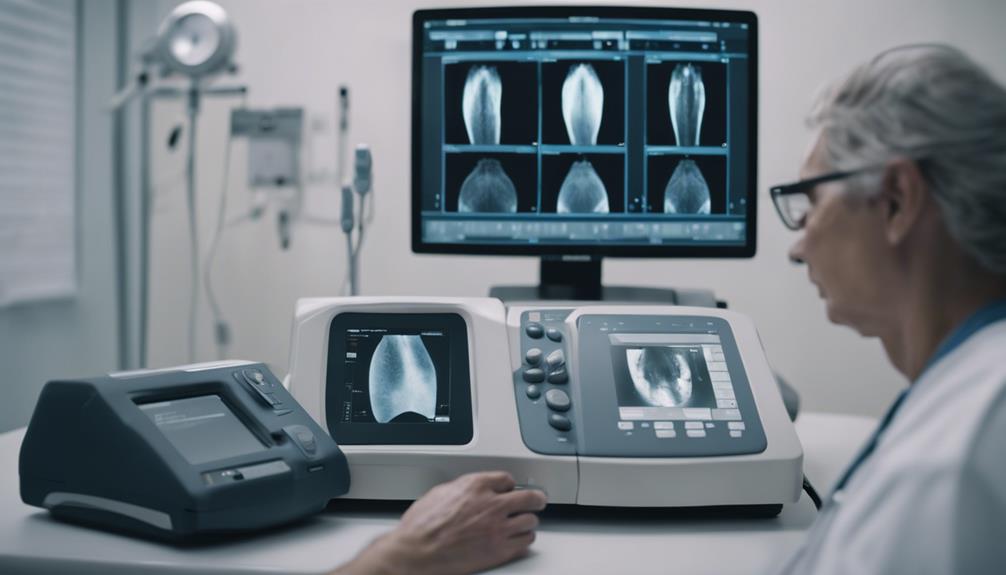
When comparing portable ultrasound scanners to traditional systems, several advantages become immediately apparent. You'll notice that portable ultrasound scanners aren't only smaller and lighter but also easier to transport. This makes them ideal for use in various clinical settings, whether at a patient's bedside or in remote field locations.
Despite their compact size, portable units don't compromise on the quality of imaging. They maintain high-quality imaging capabilities, often rivaling those of their bulkier counterparts. Plus, with AI integration, these devices offer enhanced diagnostic support, which can be a game-changer in making swift, accurate assessments.
Cost is another major factor. While traditional ultrasound machines can be quite expensive, ranging from $40,000 to $200,000, portable ultrasound scanners like the Butterfly iQ are priced around $2,000, offering a more cost-effective solution without sacrificing performance.
Furthermore, the ease of use and workflow efficiency are greatly improved with portable systems. They allow for real-time imaging and immediate patient assessment, eliminating the need for dedicated space and setup time.
Their intuitive interfaces and wireless functionality contribute to a user experience that's more flexible and less cumbersome than traditional systems.
Future Prospects and Developments
Building on the advantages of portable ultrasound systems, future developments are set to revolutionize how medical professionals approach diagnostics. As you look ahead, you'll see AI integration playing a significant role. This technology is designed to boost diagnostic accuracy and streamline your workflow by automating both the capture and interpretation of images.
Imagine the efficiency you'll gain with these smarter systems at your fingertips.
Moreover, the introduction of 3D imaging and enhanced Doppler functionalities will expand the applications of portable ultrasound across various medical fields. You'll witness a significant improvement in imaging capabilities, which is vital for more precise diagnoses.
The demand for real-time imaging solutions is climbing, particularly in emergency and critical care settings. This need is even more pronounced in low-resource environments where traditional medical infrastructure might lag.
Thanks to ongoing developments in tele-ultrasound technology, remote consultations and diagnostics will become more accessible, especially in rural and underserved regions.
Lastly, don't overlook the importance of training and education. Enhanced efforts in these areas are essential for you and your peers to fully leverage the benefits of portable ultrasound, ensuring improved patient care and outcomes as these technologies evolve and become more integrated into everyday practice.
How Can a Portable Ultrasound Scanner Benefit Hospitals and Medical Facilities?
The best bladder scanners for hospitals allow for quick and non-invasive measurements, speeding up patient flow and improving overall efficiency. Portable ultrasound scanners can benefit medical facilities by providing easy access to valuable diagnostic tools, leading to improved patient care and more accurate diagnoses.
Frequently Asked Questions
What Is the Purpose of a Portable Ultrasound Machine?
You're using a portable ultrasound machine to leverage cutting-edge medical field innovations.
It's essential for diagnostic imaging applications, from emergency room assessments to patient monitoring solutions.
The benefits extend to veterinary medicine and home healthcare, offering versatile, real-time visuals of internal body structures.
This tool greatly enhances patient care, allowing for immediate diagnosis and timely intervention, making it invaluable in diverse medical settings.
What Is the Purpose of the Ultrasound Scanner?
As a doctor, you'd use an ultrasound scanner for various reasons.
It's vital for diagnostic imaging, helping you assess internal body structures swiftly. In emergency services, it's indispensable for real-time patient monitoring.
It's also essential in prenatal care, vascular assessment, and even managing pain.
This technology supports numerous medical applications, offering you quick insights that are significant in making informed decisions about your patient's health, directly at their bedside.
What Can an Ultrasound Machine Be Used For?
You can use an ultrasound machine for a variety of purposes including diagnostic imaging in prenatal care to monitor fetal health.
It's essential in emergency medicine for quick internal assessments, musculoskeletal evaluations, and abdominal checks.
Additionally, it aids in cardiac monitoring and is even used in veterinary applications.
This versatility makes it invaluable in healthcare, providing critical information that guides treatment decisions across different medical specialties.
What Are the Disadvantages of Portable Ultrasound?
You'll find that portable ultrasound devices, while handy, come with several drawbacks.
They often have accuracy issues due to limited features and compromised image quality. The reduced functionality can challenge your diagnostic capabilities.
Also, their battery life may disrupt continuous usage. Furthermore, these devices require specific training, which can vary widely among users, potentially leading to errors.
Despite their mobility, the portability challenges and cost considerations are significant.
Conclusion
You've seen how portable ultrasound scanners revolutionize healthcare, especially in emergencies and remote locations. These devices not only offer real-time insights for immediate decision-making but also promise advancements that could further enhance their utility and accessibility. As technology progresses, you can expect them to become even more integral in medical diagnostics, outshining traditional systems with their convenience and efficiency. The future looks bright as these tools continue to evolve, bringing critical care closer to those in need.
