
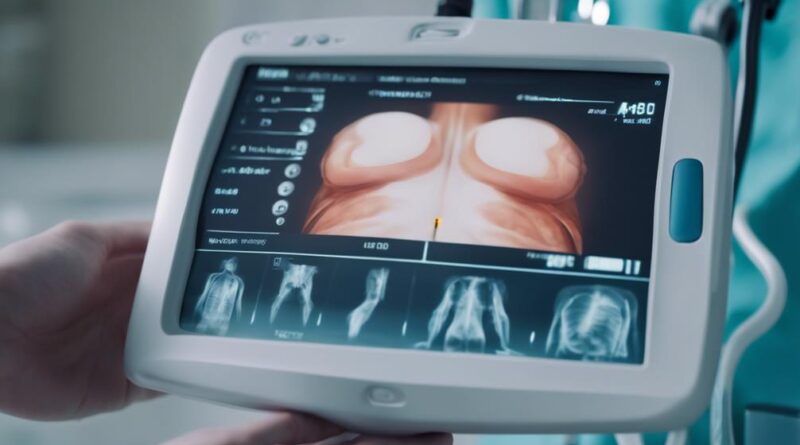
How Does Automated Bladder Scanning Work?
Have you ever wondered how medical professionals quickly and accurately measure bladder volume without invasive procedures? Automated bladder scanning utilizes sophisticated ultrasound technology to generate real-time images and precise volume measurements. This tool is essential in evaluating urinary retention and preventing unnecessary catheterizations, which can lead to infections. As you sit comfortably during the scan, you might be curious about the underlying technology and its implications in modern healthcare. What makes this method so effective and preferred in clinical settings? Let's explore how this technology stands out and its potential impact on patient care.
Key Takeaways
- Automated bladder scanning employs ultrasound technology to measure bladder volume non-invasively.
- Sound waves are emitted by the ultrasound transducer to capture real-time bladder images.
- The ImageSense AI technology enhances accuracy, achieving a standard deviation of ±7.5% for volumes over 100 mL.
- Auto-location and aiming assist features streamline the scanning process, minimizing user error.
- The intuitive touchscreen interface provides live imaging and guides the user through the scanning procedure.
Background and Importance
Automated bladder scanning revolutionizes how medical professionals assess bladder function, using advanced ultrasound technology to measure bladder volume non-invasively. This method allows you to gauge the post-void residual (PVR) urine more accurately, which is vital in determining whether your bladder empties properly after urination.
By regularly monitoring bladder volume measurements, you're better equipped to detect urinary retention early on, potentially avoiding severe complications.
The technology's ability to reduce the need for catheterization is a significant boon. Typically, catheters are linked to a high incidence of urinary tract infections (UTIs), particularly catheter-associated UTIs (CAUTIs), which make up about 80% of all nosocomial UTIs.
By opting for automated bladder scanning, you're not just choosing a safer alternative; you're also cutting down on the risk of infections that can complicate the clinical outcome.
Moreover, the precision offered by ultrasound technology in these devices guarantees that the readings of your bladder's volume are dependable, supporting timely and accurate clinical decisions.
This not only improves your care quality but also enhances overall patient management and outcomes in healthcare settings, making automated bladder scanning a critical tool in modern medical practice.
Understanding the Technology
To grasp how automated bladder scanning works, you'll first need to understand the core scanning principles and key technological components involved.
The device relies on ultrasound technology, emitting sound waves that reflect off your bladder to accurately measure its volume.
Additionally, features like real-time auto-location and advanced algorithms, including ImageSense™, play essential roles in enhancing the accuracy and ease of the scanning process.
Core Scanning Principles
Understanding the core principles of automated bladder scanning technology is vital for effectively leveraging its capabilities. At its heart, automated bladder scanning utilizes ultrasound technology, a sophisticated yet user-friendly method that guarantees you can assess bladder volume accurately and noninvasively.
By emitting sound waves using a handheld transducer, the technology captures real-time images of the bladder. These images are essential for immediate assessment, minimizing the need for invasive procedures like catheterization.
This technology isn't just about taking pictures; it's enhanced by advanced algorithms, such as ImageSense AI, which notably boosts the accuracy and consistency of the measurements. You're looking at an accuracy rate of ±7.5% for volumes over 100 mL, making it a reliable tool in clinical settings.
The process is streamlined through features like auto-location and automated aiming assist, which together reduce the potential for user error dramatically.
Moreover, the results of your scan aren't just numbers and graphs; they're displayed on a large touchscreen interface with intuitive graphics. This setup helps you interpret the results effectively and efficiently, guaranteeing that you can make informed decisions quickly.
Key Technological Components
Building on the foundations of automated bladder scanning technology, let's explore the key technological components that make this system so effective. At the heart of this method is advanced ultrasound technology, which emits sound waves that reflect off your bladder, enabling precise, non-invasive volume measurements.
Here are the three main components that elevate the efficiency and accuracy of automated bladder scanning:
- Ultrasound Transducer Technology: This is essential for emitting sound waves accurately towards the bladder. The reflected waves are then captured to determine bladder volumes with high precision.
- ImageSense™ AI Technology: Incorporating artificial intelligence, this feature boosts the accuracy of the scans. It standardizes results across different users and conditions, maintaining an accuracy rate of ±7.5% for volumes over 100 mL. This is particularly critical in clinical environments where consistency is key.
- Intuitive Touchscreen Interface: The large, user-friendly touchscreen simplifies the scanning process. It not only guides you through each step but also features real-time auto-location and live B-mode imaging.
This assists in pre-scan aiming and guarantees the automated aiming assist feature seamlessly integrates into the workflow, enhancing diagnostic efficiency and reducing the need for complex manual techniques.
Clinical Applications

Why should healthcare professionals consider automated bladder scanning in clinical applications? Automated bladder scanning is a game-changer for managing patient care, especially in accurately measuring bladder volume and post-void residual (PVR). This non-invasive, quick method reduces the risk of urinary tract infections (UTIs) by minimizing unnecessary catheterizations.
Here's how automated bladder scanning benefits specific patient groups:
| Patient Group | Benefit of Scanning | Key Advantage |
|---|---|---|
| Post-surgical Patients | Prevents unnecessary catheterizations | Reduces risk of catheter-related UTIs |
| Patients with Neurogenic Bladder | Accurate monitoring of bladder function | Enhances personalized treatment plans |
| Elderly Patients | Easy monitoring without discomfort | Promotes independence and comfort |
| Patients in Rehabilitation | Frequent, non-invasive assessments | Supports quicker recovery process |
Utilizing automated bladder scanning in these clinical settings helps you as a healthcare provider to make informed decisions swiftly. You'll streamline your workflow, enhance the precision of bladder volume measurements, and ultimately, improve the quality of patient care. Remember, each scan you perform is a step towards a safer, more efficient healthcare environment.
Benefits of Automated Scanning
You'll find that automated bladder scanning offers significant advantages.
Enhanced diagnostic accuracy guarantees you're getting reliable data with every scan, thanks to precise technology like ImageSense AI.
This not only reduces the need for catheter use but also streamlines your clinical workflow, making your job easier and more efficient.
Enhanced Diagnostic Accuracy
Automated bladder scanning dramatically enhances diagnostic accuracy in measuring bladder volume. Utilizing cutting-edge technologies like ImageSense™ AI, this noninvasive method achieves an impressive accuracy rate of ±7.5% for volumes over 100 mL. You'll find that these precise bladder volume measurements are essential in preventing and managing urinary tract infections (UTIs), especially those associated with catheter use.
Here's how automated bladder scanning benefits you:
- Precision: Real-time auto-location and live B-mode imaging enable precise targeting of the bladder. This accuracy is critical in clinical settings, reducing the guesswork and potential errors associated with manual methods.
- Efficiency: The streamlined point-and-click scanning process not only makes the task quicker but also easier. This means healthcare providers can focus more on patient care rather than technical complexities.
- Safety: By greatly decreasing the risk of catheter-associated UTIs, which constitute about 80% of nosocomial UTIs, automated scanning guarantees a safer environment for both patients and healthcare workers.
The BladderScan i10 model further supports this technology with an intuitive interface, guiding users through each step, ensuring that you're equipped to make the best-informed decisions for your patients.
Reduced Catheter Use
Reducing catheter use has become a key benefit of automated bladder scanning, offering a non-invasive method to assess post-void residual volume (PVR) accurately. By using this technology, you're stepping away from traditional catheterization, which not only is more invasive but also carries a higher risk of complications, such as urinary tract infections.
Automated bladder scanning greatly decreases the frequency of catheter use. This reduction is vital because it directly minimizes your risk of catheter-associated urinary tract infections (CAUTI), which are a major concern in medical settings. Remember, these infections account for about 80% of all nosocomial UTIs. Here's a quick look at the benefits in a simple table:
| Benefit | Impact on Healthcare | Patient Experience |
|---|---|---|
| Reduced CAUTI risks | Decreased UTI cases | Safer recovery |
| Lower need for catheterization | Cost savings | Increased comfort |
| Quick PVR assessment | Less invasive procedures | Faster diagnosis |
Streamlined Clinical Workflow
Enhancing your clinical workflow becomes effortless with the integration of automated bladder scanning technology like the BladderScan i10. This advanced tool streamlines your day-to-day operations and greatly improves patient care.
Here's how automated bladder scanners revolutionize clinical workflows:
- Accuracy and Speed: The BladderScan i10 features ImageSense AI, ensuring bladder volume measurements are consistently accurate within ±7.5% for volumes over 100 mL. This precision allows you to make quicker, more reliable decisions without the need for invasive procedures.
- Reduced Invasive Procedures: By accurately evaluating bladder volumes, these scanners minimize unnecessary catheterizations, reducing the risk of catheter-associated urinary tract infections (CAUTI). This not only enhances patient safety but also cuts down on associated healthcare costs and complications.
- Ease of Use: With a user-friendly touchscreen interface and point-and-click 3D scanning capabilities, the BladderScan i10 simplifies the learning curve for new users.
This accessibility speeds up the bladder evaluation process, allowing for more efficient patient management across various healthcare settings.
Operational Procedure

To begin using an automated bladder scanner, first make sure the device is powered on and fully charged. Next, prepare the BladderScan i10 by calibrating the handheld probe. Here's how you'll proceed with the operational procedure:
- Position the patient lying flat on their back for ideal accuracy.
- Apply a liberal amount of ultrasound gel on the probe to guarantee good contact with the skin and minimize air gaps which can interfere with sound wave transmission.
- Place the probe on the lower abdomen, midway between the navel and the pubic bone. The BladderScan i10's aiming assist will help you locate the bladder efficiently.
Now, initiate the scan. The ultrasound technology within the handheld probe emits sound waves that reflect off the bladder, capturing real-time images. These images are then processed by the scanner's advanced software to estimate the bladder volume accurately.
Here's a snapshot of the process:
| Step | Action | Outcome |
|---|---|---|
| Preparation | Power on, calibrate, apply gel | Ready to scan |
| Positioning | Patient supine, probe placed correctly | Ideal scanning angle |
| Scanning | Activate scan | Sound waves emitted |
| Result Display | View on touchscreen | Bladder volume displayed |
This efficient method guarantees you get a precise measurement with minimal discomfort for the patient.
Safety and Side Effects
Automated bladder scanning is renowned for its safety, posing no known side effects and ensuring a risk-free procedure for patients of all ages. This non-invasive technology allows you to avoid the discomfort and risks associated with more invasive procedures.
You won't need sedation or intubation, which not only reduces patient discomfort but also diminishes potential complications.
Here are three significant benefits of automated bladder scanning:
- Minimizes Risk of UTIs: By avoiding unnecessary catheterization, the risk of developing urinary tract infections is drastically reduced. Remember, UTIs can occur in about 2.3% of catheterized females.
- Reduces Patient Discomfort: The procedure itself is simple and gentle. You'll experience minimal discomfort compared to traditional methods that might require more invasive approaches.
- Acts as a Preventative Measure: Not using automated bladder scanning can lead to serious complications such as UTIs and bladder overdistension. By opting for this method, you're taking an essential step in preventing these issues.
Automated bladder scanning stands out as a preferable choice in medical imaging, ensuring your health is monitored efficiently and comfortably, without the fear of side effects.
Economic Impact

While automated bladder scanning considerably improves patient safety, it also offers compelling economic benefits. By using devices like the BladderScan i10, you're not just ensuring accurate bladder assessments; you're also cutting down on the incidence of catheter-associated urinary tract infections (CAUTIs).
These infections, responsible for about 80% of hospital-acquired UTIs, can be a massive financial strain, costing as much as $8,700 per case in intensive care settings.
Consider this: a budget impact analysis revealed that implementing portable bladder ultrasound devices in complex continuing care facilities led to annual savings of approximately $192,499 per facility.
Across 15 facilities, that's a stunning total of $2,887,485 saved. These cost savings stem from reduced CAUTI rates and the associated decrease in intensive treatments and prolonged hospital stays.
Moreover, by minimizing unnecessary catheterization with non-invasive bladder scanning, you're not only preventing discomfort but also reducing overall healthcare delivery costs.
The BladderScan ROI calculator projects over $150,000 in savings for a 100-bed facility. So, you're not just improving patient care—you're also making a financially savvy decision that can streamline workflows and shorten hospital stays.
Future Developments
Looking ahead, the landscape of automated bladder scanning is set to transform markedly with advancements aimed at increasing precision and ease of use.
You'll witness significant improvements in real-time bladder auto-location, enhancing accuracy and minimizing the need for invasive procedures.
Here's what's on the horizon:
- Integration of Advanced AI: Technologies like ImageSense™ are refining automated bladder scanning with advanced artificial intelligence. They're pushing accuracy rates to ±7.5% for volumes over 100 mL, ensuring you get reliable data every time.
- Development of Portable Devices: Expect to see even more portable devices that are noninvasive and exceptionally user-friendly. These innovations make it feasible for healthcare professionals to conduct scans effortlessly across multiple settings, without needing extensive training.
- Wireless and App-Based Platforms: The future includes wireless technologies and app-based platforms that facilitate remote monitoring and data sharing. This capability enables better collaborative care and efficient patient management.
These advancements are set to expand the applications of automated bladder scanning into areas like pediatric care and emergency medicine, revolutionizing how patient outcomes are approached and improving overall clinical workflow.
Frequently Asked Questions
How Does a Bladder Scanner Work?
You use a bladder scanner to measure urine volume non-invasively, enhancing patient comfort notably.
This technology uses ultrasound waves, processed by advanced software to guarantee accuracy.
Frequent scanning can prevent severe urinary issues and supports numerous healthcare applications.
The benefits of using this device include reducing the risk of infections and promoting quicker clinical decision-making, which altogether streamlines patient management in various medical settings.
How Does a Bladder Ultrasound Work?
To assess your bladder health, a bladder ultrasound uses ultrasound technology.
It's a diagnostic imaging tool that helps detect urinary retention and guarantees patient comfort. The device sends sound waves to your bladder, capturing reflections to measure volume accurately.
This non-invasive method enhances safety and comfort by avoiding catheters, reducing infection risks. It's quick and efficient, providing real-time results that aid in immediate medical decision-making.
What Is the Disadvantage of Bladder Scanner?
Bladder scanners have several disadvantages. You might find their accuracy compromised by factors like pelvic masses or scarring, potentially leading to false readings.
They require user training, which can be a hurdle in swift clinical adaptation. Although non-invasive and generally comfortable for patients, these scanners can be costly and necessitate frequent technology updates to stay effective.
Such limitations mean they're not always the most cost-efficient or reliable method in every clinical scenario.
How Accurate Is the Bladder Scanner?
You're likely curious about the accuracy of the bladder scanner. With an accuracy rate of ±7.5% for volumes over 100 mL, it guarantees clinical reliability.
The measurement techniques, like BladderTraq and automated aiming, reduce user error, enhancing patient comfort. Proper user training is essential to maximize the device's potential.
Conclusion
You've seen how automated bladder scanning revolutionizes patient care by using ultrasound technology to accurately measure bladder volume. This non-invasive method not only enhances patient comfort by avoiding catheterization but also reduces the risk of infections. It's efficient, safe, and cost-effective, continuously improving with technological advancements. As you move forward, consider the significant benefits and growing accessibility of this procedure in clinical settings, ensuring better patient outcomes and streamlined healthcare processes.
