
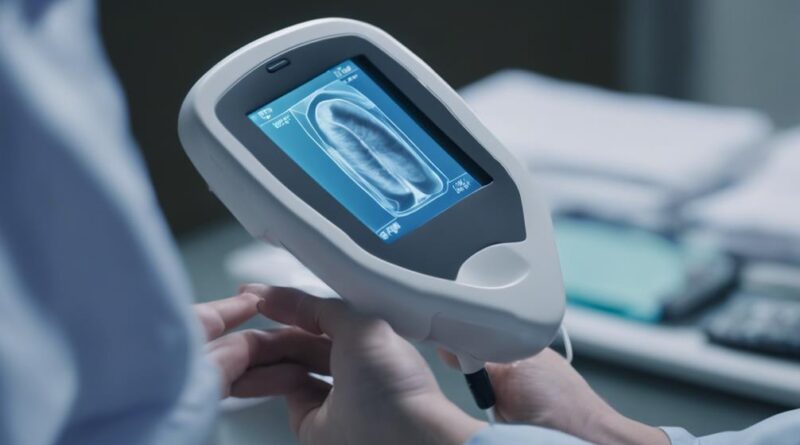
What Are the Advancements in Bladder Scanning Technology?
You've likely heard of ultrasound technology, but have you kept up with how it's revolutionizing the way healthcare professionals manage bladder health? Recent advancements in bladder scanning technology now allow for more precise measurements with less discomfort for patients. These state-of-the-art devices not only offer 3D visuals but are also increasingly portable, making them ideal for use in various clinical settings. Imagine the implications for patient care and the potential for reducing invasive procedures. But what's truly exciting is where this technology might lead next. Let's explore how these innovations could further transform diagnostics in ways we've yet to fully grasp.
Key Takeaways
- Transition from bulky mechanical devices to compact, electronic models enhances portability and ease of use.
- Incorporation of high-frequency ultrasound technology improves the accuracy of bladder volume assessments.
- Wireless technology enables real-time data transfer and remote patient monitoring capabilities.
- Integration of user-friendly interfaces simplifies operation, requiring minimal training for healthcare professionals.
- Future developments include AI integration for optimized volume measurement and automated data interpretation.
Device Overview and Functionality
How have bladder scanners transformed patient care? With advances in ultrasound technology and the integration of AI algorithms, these devices now offer highly accurate assessments, essential for enhancing clinical decision-making.
Bladder scanners have evolved into sophisticated tools that utilize high-frequency sound waves to generate detailed 3D images of the bladder, ensuring precise measurements of bladder volume. This leap in bladder scanners accuracy with non-invasive procedures greatly boosts patient comfort, as there's no need for catheterization, reducing the risk of infection and discomfort.
These advanced bladder scanners are also designed as portable devices, easy to maneuver around patient care settings. You'll appreciate the lightweight, user-friendly interfaces that allow healthcare professionals to operate them efficiently with minimal training.
The integration of wireless technology enables seamless data transfer, facilitating real-time monitoring and even remote assessments. This capability not only improves patient care but also expedites decision-making processes, ensuring that you can monitor bladder health more effectively and responsively.
Target Population and Benefits
With recent advancements in bladder scanning technology, patients with conditions like paralysis, spina bifida, bladder cancer, and end-stage bladder disease now experience significant benefits. You'll find that these advancements are essential in providing non-invasive monitoring which greatly alleviates the discomfort usually associated with traditional catheter use.
Here's a breakdown of how these advancements impact different aspects of healthcare:
| Benefit | Description | Impact on Patient Care |
|---|---|---|
| Non-invasive Monitoring | No need for invasive procedures | Reduces patient discomfort |
| Accurate Volume Assessments | Up to 98% accuracy with portable models | Enhances decision-making accuracy |
| Continuous Monitoring | Real-time updates on bladder function | Improves response to urinary retention |
Portable bladder scanners mean healthcare professionals can now carry out accurate volume assessments in various settings, not just at fixed locations. This flexibility improves patient care by enabling continuous monitoring and timely interventions, particularly in managing urinary retention and complications related to it. Enhanced accuracy guarantees that treatments are based on reliable data, which reduces unnecessary interventions and focuses on improving patient outcomes.
Bladder Regeneration Integration

As you explore the latest in bladder regeneration, you'll find that stem cell seeded patches represent a groundbreaking stride.
These biodegradable scaffolds, enhanced with your own stem cells, not only foster the growth of new bladder tissue but also decrease the risk of complications seen with older methods.
Additionally, their citric acid base allows these scaffolds to mimic the natural elasticity of bladder tissue, promising smoother recovery and better functional outcomes.
Stem Cell Seeded Patches
Researchers at Northwestern University have developed a groundbreaking technique in bladder regeneration, utilizing biodegradable patches seeded with a patient's own stem cells. These biodegradable bladder patches are a novel approach to fostering bladder tissue growth, aiming to replace the problematic traditional bladder augmentation methods that typically involve bowel tissue.
Here's why this development is capturing the attention of the medical community:
- Reduced Complications: Unlike traditional methods, these patches minimize the complications linked to bladder reconstruction.
- Physiologically Compatible: The patches are made from a citric acid-based material that mirrors the soft and elastic characteristics of natural bladder tissue, making them easy to integrate and suture.
- Promotes Tissue Regeneration: The stem cells on the scaffolds actively participate in generating new, healthy bladder tissue, closely resembling the tissue's normal state.
- Ready for Clinical Trials: Given their success in baboon models, these patches are paving the way for potential clinical trials, promising a significant advancement in bladder health management.
You're witnessing a shift towards more effective and patient-friendly bladder health solutions, offering hope for those needing bladder reconstruction without the severe complications of traditional methods.
Biodegradable Scaffold Benefits
Over time, biodegradable scaffolds have revolutionized bladder regeneration by creating an environment that closely mimics the natural tissue of the bladder. These scaffolds, developed using citric acid, are not only soft and elastic but also suture-able, making them ideal for augmented tissue engineering. They dissolve over time, allowing your body to naturally rebuild the bladder tissue without the need for additional surgeries to remove the implant.
Research has shown that these scaffolds markedly reduce complications compared to traditional methods like ileum augmentation, which often leads to anatomical and physiological incompatibility. In preclinical studies, particularly those involving baboon models, the regenerated tissue from biodegradable scaffolds exhibited similar composition to normal bladder tissue, proving their effectiveness in supporting healthy tissue development.
Here's a quick look at the key benefits:
| Feature | Benefit | Comparison to Traditional Methods |
|---|---|---|
| Anatomical Compatibility | Matches bladder shape and size | Superior to ileum segment use |
| Physiological Compatibility | Promotes natural tissue function | Reduces rejection and complications |
| Scaffold Dissolution | Eliminates need for surgical removal | Simplifies post-operative care |
| Clinical Trial Potential | Supported by successful preclinical studies | Paves way for advanced treatments |
These advancements suggest a promising future for clinical trials and the broader adoption of biodegradable scaffolds in bladder regeneration therapies.
Future Developments
Exciting advancements in bladder scanning technology are on the horizon, promising to transform both diagnostics and patient care. As you look forward to the future, you'll find several key developments that will enhance how bladder health is monitored and managed.
- Advanced Imaging Techniques: Upcoming bladder scanner technologies will utilize superior imaging methods, greatly improving the clarity and detail of scans. This enhancement won't only boost diagnostic accuracy but also refine the user experience for both patients and clinicians.
- Artificial Intelligence Integration: AI will play a pivotal role, optimizing volume measurements and automating data interpretation. This will guarantee quicker, more accurate diagnoses, reducing the time you spend waiting for results.
- Portable and Telehealth Compatible Scanners: The next generation of portable scanners will facilitate remote patient monitoring and be integral to telehealth, allowing you to perform scans at home and share results instantly with your healthcare provider.
- Interactive Interfaces for Enhanced Engagement: Expect to see interactive interfaces designed to increase patient engagement. These user-friendly platforms will help demystify the scanning process and provide personalized reports, making it easier for you to understand and manage your health.
These innovations in bladder scanner technologies are designed to empower you, making healthcare more accessible, efficient, and patient-centered.
Health Research and Urban Environment

As you explore the intersection of health research and urban environments, it's critical to contemplate how urban green spaces not only enhance community well-being but also potentially impact cancer treatment outcomes.
You'll find that disparities in cancer treatments among different populations are stark, with Black patients often facing more aggressive tumors than their white counterparts.
This underscores the need for targeted healthcare strategies that effectively address these gaps within the complexities of urban settings.
Urban Green Space Benefits
Urban green spaces like parks and gardens aren't just for leisure; they're essential for your health. Much like advancements in bladder scanning technology have revolutionized healthcare by improving patient care, enhancing patient outcomes, and reducing patient discomfort through non-invasive procedures, urban green spaces greatly enhance your physical and mental well-being.
Here's how being near nature can impact your life:
- Heart Health: Regular visits to green spaces are linked with better heart health, thanks to the stress-reducing effects of nature.
- Mental Wellness: Proximity to parks and gardens correlates with lower anxiety and depression levels, fostering better mental health.
- Community Well-being: Green spaces encourage physical activities and social interactions, strengthening community ties.
- Relaxation and Recreation: These areas provide essential spaces for relaxation, helping improve your overall quality of life.
Cancer Treatment Disparities
Why do cancer treatment disparities persist in urban environments? It's a complex issue rooted in socio-economic factors that limit your access to quality healthcare resources. You might live in an area where healthcare facilities lack the advanced regenerative engineering technologies necessary for precise diagnosis and effective treatment. This gap in diagnostic capabilities can lead to poorer outcomes for you compared to someone in a more affluent area.
Disparities in cancer treatment aren't just about geography; they're also about race and economic status. Studies have found that uterine tumors are more aggressive in Black patients than in white patients, underscoring the need for tailored healthcare approaches that consider your unique genetic and environmental background. This tailored approach guarantees that treatments meet your specific patient needs, greatly improving patient outcomes.
Moreover, these disparities call for targeted interventions. Enhanced healthcare access through policies that bridge the gap between marginalized communities and high-quality cancer care is essential.
You deserve a healthcare system that not only understands but also addresses the diverse challenges faced by urban populations, guaranteeing that everyone has a fair chance at fighting cancer.
Community Engagement and Subscription Services
To keep you connected and engaged with campus life, Northwestern Now offers a subscription service that delivers the latest stories and updates straight to your inbox.
This service isn't just about keeping you in the loop; it's a crucial tool for deepening your connection with the community and staying informed about the advancements and innovations at Northwestern University.
Here's what you can expect from the subscription:
- Curated Content: Each update is tailored to highlight significant topics and local developments that impact both the university community and the broader field of healthcare.
- Community Engagement: Discover opportunities to participate in campus events and initiatives that enhance patient care and healthcare education.
- Timely Updates: You'll receive information as it happens, ensuring you're always informed about the latest research and advancements without delay.
- Local Developments and Innovations: Stay ahead of the curve on what's new and remarkable around campus and in the wider healthcare community.
Evolution of Bladder Scanners

With advances in technology, bladder scanners have undergone considerable transformations, evolving from cumbersome mechanical devices to today's compact, efficient electronic models. You've likely noticed how these devices have changed, not just in size but in their functionality and the precision they offer. Modern bladder scanners now utilize high-frequency sound waves, which allow for highly accurate bladder volume assessments through advanced 3D imaging techniques.
Here's a quick look at how these advancements have unfolded:
| Feature | Old Model | Modern Model |
|---|---|---|
| Size & Portability | Bulky and stationary | Lightweight & portable |
| Technology | Basic ultrasound | High-frequency, 3D imaging |
| Ease of Use | Requires calibration | No calibration needed |
| Connectivity | Wired connections | Wireless technology |
| Accuracy | Moderate | Up to 98% accuracy |
These enhancements have made it easier for you to conduct patient assessments with greater efficiency. The integration of portable and handheld designs, coupled with wireless technology, supports seamless data transfer and enables remote monitoring. As you continue using these tools, you'll find that the evolution of bladder scanners considerably enhances your ability to provide care, ensuring that each assessment is as accurate and efficient as possible.
Functionality of Bladder Scanners
Building on the technological innovations outlined earlier, the functionality of bladder scanners today offers unprecedented accuracy and ease of use. Advanced bladder scanners utilize high-frequency ultrasound waves to create a detailed 3D image of your bladder. This technology guarantees that you're getting the most accurate measurements possible, enhancing the overall diagnostic capabilities in healthcare settings.
These devices are remarkably non-invasive, eliminating the discomfort and risks associated with traditional catheterization methods. You'll appreciate how these advancements contribute to a more pleasant patient experience.
Moreover, the advent of portable models has revolutionized how healthcare professionals interact with bladder scanning technology. With these portable units, nurses and healthcare assistants can easily perform scans right at the bedside, following just minimal training.
Here's what makes modern bladder scanners essential in today's medical field:
- High Accuracy Rate: Modern scanners boast an accuracy rate of up to 98%, guaranteeing reliable diagnostics.
- Automatic Multi-plane Scanning: Devices automatically scan across 12 different planes, reducing user error and improving precision.
- Portable Convenience: Lightweight, handheld models bring technology directly to the patient's side.
- Non-Invasive Procedure: A completely external process that enhances patient comfort and reduces procedural risks.
Intended Use Cases

Bladder scanners play an important role in modern healthcare, offering precise bladder volume measurements essential in various settings such as urology, surgery, and primary care. These devices are critical for you as a healthcare provider, enabling you to manage patient care effectively.
They're particularly beneficial in monitoring urinary retention, especially in postoperative patients. This non-invasive tool helps you guarantee timely interventions, greatly reducing the risk of complications that might otherwise arise.
You'll find that bladder scanners are indispensable in preventing catheter-associated urinary tract infections. By accurately measuring bladder volume, you can make informed decisions about catheterization, minimizing unnecessary procedures and thereby reducing infection risks. This is especially important in patients who are immunocompromised or have conditions that complicate traditional catheterization methods.
Moreover, the user-friendly designs of modern bladder scanners enhance workflow efficiency. Even healthcare assistants and nurses, after minimal training, can operate these devices effectively, assuring that patient care isn't only efficient but also consistent across various healthcare settings.
This seamless integration into daily routines underscores the scanners' value in improving both patient outcomes and operational productivity in your practice.
Frequently Asked Questions
How Accurate Are Bladder Scans Currently?
Bladder scan accuracy currently varies, but most devices show a high reliability rate, often reaching up to 98% with advanced ultrasound technology.
These scans improve patient comfort, are cost-effective, and the frequency of updates enhances diagnostic effectiveness.
Measurement techniques and clinical applications benefit from ongoing advancements in technology.
Comparing different equipment, you'll find that newer models integrate better technology, offering more precise measurements and increasing overall scan reliability.
What Is the Best Scan for the Bladder?
The best scan for your bladder leverages ultrasound technology, ensuring high diagnostic accuracy and patient comfort.
It's essential for detecting urinary retention and improving bladder health.
Modern scan procedures utilize advancements in healthcare to enhance clinical applications and treatment options.
These devices are non-invasive, fostering better patient education about their conditions.
With these improvements, you're looking at a technology that markedly eases the process while reducing risks.
What Are the Different Types of Bladder Scans?
You've got several types of bladder scans to choose from.
Ultrasound technology is common, offering portable devices that enhance patient comfort. These vary in scan frequency, tailored to different clinical applications. They're cost-effective and integrate smoothly with existing software systems.
However, each type has specific training requirements for accurate data interpretation.
Keep an eye on future innovations which may further streamline the process and improve diagnostic capabilities.
What Is the Best Imaging Modality for Bladder?
You're seeking the best imaging modality for bladder function, and ultrasound technology stands out.
It offers high diagnostic accuracy and excellent imaging resolution, vital for evaluating bladder volume. This non-invasive method enhances patient comfort since it's painless and quick.
Frequent scans are manageable with minimal discomfort. Plus, ongoing innovations in clinical applications promise even greater precision in the future.
For both current and emerging needs, ultrasound is your best choice.
Conclusion
As you explore the advancements in bladder scanning technology, you'll find that these devices not only enhance patient care but also streamline healthcare operations. They're designed for ease, with functionality that supports quick, accurate assessments and improves both patient outcomes and workflow efficiency. Moving forward, expect even more innovative features, integrating bladder regeneration and expanding into urban health research. Your engagement with these technologies could revolutionize how healthcare providers approach bladder-related diagnostics and treatments.
