

How Does a 3D Bladder Scanner Differ From 2d?
When you compare a 3D bladder scanner to its 2D counterpart, you're looking at a leap in imaging technology that could transform how medical professionals approach diagnostics. Unlike the 2D scanner, which provides a flat, often imprecise image, the 3D scanner offers a detailed volumetric view, capturing the bladder's shape and volume from multiple angles. This isn't just about clearer images; it's about the implications for accuracy in diagnosis and the potential for monitoring treatments more effectively. What might this mean for patient care and clinical outcomes? Consider the broader implications of adopting this technology in medical settings.
Key Takeaways
- 3D bladder scanners provide volumetric images, offering detailed views of bladder geometry, whereas 2D scanners capture only single cross-sectional slices.
- Enhanced accuracy in 3D scanners is shown by a mean error measurement of -8.48% compared to 15.7% in 2D, indicating more reliable volume assessments.
- 3D technology uses multiple angles to trace bladder circumference, improving diagnostic precision for irregular bladder shapes.
- Real-time 3D visualization in 3D scanners aids in better surgical and treatment decision-making, unlike the limited 2D imaging.
- 3D scanners integrate advanced connectivity features, such as seamless EMR integration and cloud connectivity, which are less developed in 2D scanners.
Technology Overview
In the domain of medical imaging, 3D bladder scanners represent a significant advancement over traditional 2D models. You'll find that these devices utilize cutting-edge ultrasound imaging technology to capture thorough volumetric images of the bladder. Unlike the 2D scanners, which only provide single cross-sectional slices, 3D scanners offer a detailed view of both the shape and size of the bladder.
The traditional 2D ultrasound estimates bladder volumes using linear dimension formulas, where the height, width, and length are considered to derive an approximate volume. However, these estimations often fail to capture the true complexity of the bladder's shape, particularly when it's irregular.
In contrast, 3D ultrasound imaging employs a technique that traces the bladder's outline across multiple planes. This approach doesn't just guess but rather, it continuously renders the volume, allowing for a more accurate and realistic representation.
This sophisticated volume measurement capability makes 3D scanners especially beneficial in evaluating non-uniform bladder geometries. You're less likely to see the inaccuracies common with 2D models that often either under or overestimate bladder volumes based on their geometric assumptions.
Hence, with a 3D scanner, your assessments aren't just based on estimations but on more precise and reliable visual data.
Image Accuracy
Accuracy in medical imaging is essential, and the 3D bladder scanner excels in this arena. When you're dealing with bladder volume assessments, the difference in accuracy and precision between 3D and 2D ultrasound technology is significant.
The 3D bladder scanner uses advanced imaging to create a detailed volume image. This allows for a more accurate estimation of bladder volume, especially in bladders with irregular shapes. In fact, the mean error measurement for 3D ultrasound is only -8.48%, compared to 15.7% for the 2D method.
Moreover, the correlation coefficient of 0.97 with 3D ultrasound indicates a much stronger relationship to actual bladder volumes than the 0.90 observed with 2D ultrasound. This means you're getting a truer picture of what's happening.
The R-squared value for the 3D method also approaches unity, suggesting higher precision, particularly in cases where the bladder shape isn't uniform.
Statistical analysis shows that while both methods are clinically applicable, the 3D method consistently outperforms the 2D in regards to both accuracy and precision, making it a more reliable choice for varied bladder shapes and sizes.
Measurement Techniques

You'll find that the 3D bladder scanner employs a sophisticated approach to measuring bladder volume, utilizing advanced imaging techniques to generate a complete volumetric representation. This method markedly differs from the traditional 2D ultrasound, which captures only a single plane at a time.
By tracing the bladder circumference from multiple angles, the 3D method offers a thorough assessment of bladder shape and size. This is vital as it allows for more precise calculations of bladder volume compared to the 2D methodology, which relies on linear dimension formulas based on height, width, and length.
The measurement techniques of the 3D ultrasound have shown strong agreement with actual bladder volumes, as evidenced by a Lin's concordance correlation coefficient of 0.963. Although slightly lower than the 2D method's coefficient of 0.974, the 3D approach compensates by its ability to account for irregular bladder geometries.
This feature is particularly beneficial, enhancing diagnostic accuracy especially in patients with complex bladder shapes. Despite the 3D scanner tending to underestimate bladder volume by about -4.08 mL, its capacity to provide detailed and accurate geometrical data outweighs this minor discrepancy.
Clinical Applications
You'll find that 3D bladder scanners markedly enhance diagnostic accuracy by providing a detailed view of the bladder's shape and size, which is essential when dealing with abnormal structures.
They're also invaluable for monitoring treatment outcomes in real time, offering a dynamic perspective that 2D scanners simply can't match.
Additionally, their application during surgical procedures guarantees a more precise assessment, aiding surgeons in making informed decisions intraoperatively.
Diagnostic Accuracy Enhancement
When considering clinical applications, the 3D bladder scanner greatly enhances diagnostic accuracy over its 2D counterpart. This improvement is largely due to its ability to provide extensive volumetric data and detailed visualization of the bladder. Here's how:
- Volumetric Accuracy: The 3D ultrasound method has demonstrated a correlation coefficient of 0.97 for bladder volume estimation. This is notably higher than the 2D method, which scores a 0.90. This means you're getting a more accurate measurement of the bladder volume with 3D technology.
- Irregular Shape Recognition: Unlike 2D scanners, 3D scanners excel in accounting for non-uniform bladder geometries. This feature is essential if you have an unusual bladder shape, where 2D scans might overestimate the volume.
- Enhanced Diagnostic Capabilities: With better visualization, 3D ultrasound supports improved diagnostics for conditions like urinary retention. You'll have a clearer picture of what's going on inside, leading to better-informed treatment decisions.
- Potential for Advanced Research: The precision of 3D scanning paves the way for developing "ultrasound urodynamics," which could revolutionize our understanding of bladder function.
Using a 3D bladder scanner, you're not just getting a clearer image; you're getting insights that are closer to reality, enhancing both diagnosis and subsequent care planning.
Treatment Monitoring Utility
In clinical settings, 3D bladder scanners markedly enhance the monitoring of treatment for urinary retention and other bladder-related disorders. These devices provide superior visualization of the bladder's shape and volume, allowing for more precise assessments than what you'd get with conventional 2D scanners. This precision is essential, especially when you're tracking the effectiveness of treatments aimed at managing bladder function.
With a concordance correlation coefficient of 0.963, 3D bladder scanners show a high level of accuracy in mirroring actual bladder volumes, making them reliable tools in your treatment arsenal. They're particularly adept at handling cases where the bladder may not conform to typical geometrical norms – think irregularly shaped bladders where 2D scanners might stumble, assuming uniformity where there's none.
This capability means you can make better-informed decisions on how to adjust treatment plans based on more accurate bladder volume readings. It's about getting the details right – ensuring that every therapeutic step you take is guided by the best possible data.
Interoperative Use Cases
3D bladder scanners revolutionize interoperative care by providing detailed, volumetric insights vital for complex clinical situations. Unlike their 2D counterparts, these advanced tools allow you to accurately measure urinary bladder volume, essential in many surgical and diagnostic settings.
Here's how they're transforming the landscape:
- Enhanced Diagnosis of Urinary Retention: 3D scanners outperform 2D in identifying and quantifying retention, offering precise volume assessments that guide effective treatment strategies.
- Real-Time Procedure Monitoring: The ability to monitor bladder function dynamically during procedures like urodynamics provides you with real-time data, enhancing procedural accuracy and patient safety.
- Higher Accuracy in Volume Estimation: Clinical studies have shown that 3D bladder scanners demonstrate a higher concordance correlation coefficient, ensuring that the measurements you rely on closely match the actual bladder volumes.
- Veterinary Applications: In veterinary medicine, these scanners offer a non-invasive way to assess bladder health, drastically reducing the risks associated with traditional catheterization and helping maintain animal welfare.
Device Portability
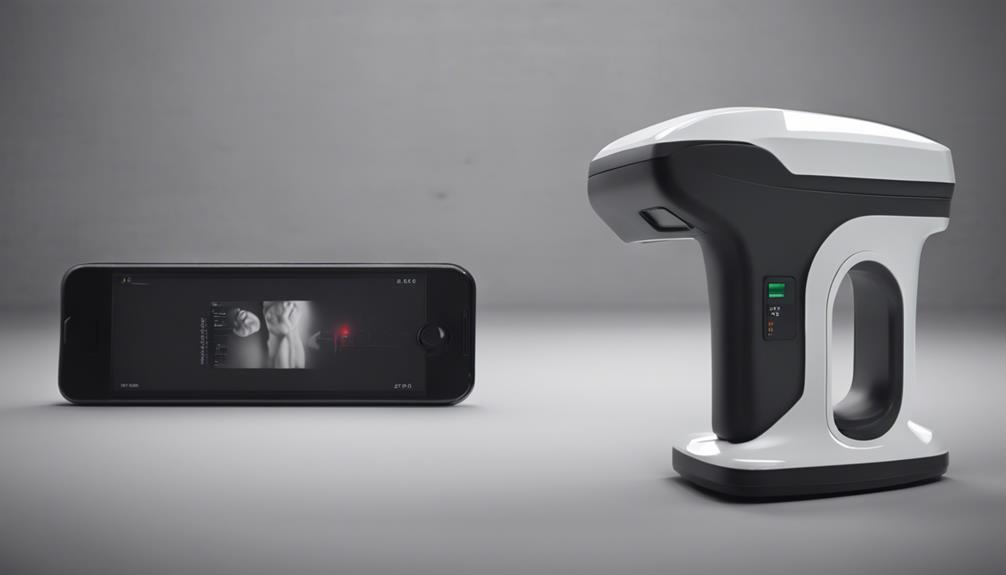
When you're considering the portability of bladder scanners, the 3D models stand out considerably.
Their compact design and lightweight features guarantee you can transport them easily across different settings, from hospitals to clinics.
This ease of movement, combined with quick setup times, makes them particularly beneficial in fast-paced clinical environments.
Ease of Transportation
Considering the need for mobility in medical devices, you'll find that 2D bladder scanners typically outperform their 3D counterparts regarding portability. When you're moving from room to room or even visiting patients at home, the lighter and more compact 2D scanners offer significant advantages.
Here's a breakdown of why the 2D portable ultrasound is often the go-to choice for healthcare professionals focused on bladder health:
- Weight and Size: 2D scanners generally weigh less than 3D scanners, making them easier to transport, especially in settings without fixed ultrasound stations.
- Battery Life: With simpler technology, 2D scanners can operate longer on a single charge, reducing the need for frequent recharging during rounds or off-site visits.
- Setup Speed: You'll appreciate the quick setup and ease of use of 2D scanners, which allows for faster patient assessments without the complex calibration required for 3D technology.
- User-Friendly Design: The streamlined interfaces and reduced physical bulk make 2D scanners less cumbersome, enhancing maneuverability in confined spaces or when immediate scanning is required.
As you consider your options, keep in mind these practical factors that contribute directly to the efficiency and effectiveness of medical care.
Compact Design Benefits
While 2D bladder scanners have their advantages regarding weight and setup speed, the innovative design of 3D bladder scanners enhances their overall portability, making them exceptionally suitable for dynamic clinical settings.
The compact design of a 3D bladder scanner truly sets it apart. It's not just about being smaller; it's about smarter utilization of space, allowing for easier handling and maneuverability. Picture yourself maneuvering through busy hospital corridors or moving between cramped patient rooms; this portable nature comes in handy, doesn't it?
Moreover, these scanners aren't just easy to carry around. They're designed to be lightweight, considerably reducing the strain on you while transporting them from one department to another.
And let's not forget the integrated rechargeable batteries – they're game changers. You're no longer tethered to a power outlet, which enhances your mobility and ability to respond quickly in various situations.
Additionally, the user-friendly interfaces and touchscreens streamline the setup process, making these devices ready to go in moments.
And because they fit neatly on standard medical carts, integrating a 3D bladder scanner into your daily workflow is seamless. You won't need to rearrange your space or invest in new storage solutions.
User Interface
Immerse yourself in the world of 3D bladder scanners and you'll discover a user interface designed to enhance your diagnostic capabilities greatly. Unlike the more basic 2D scanners, the 3D scanner's interface offers a dynamic, real-time visualization of bladder volume, allowing you to see the organ in three dimensions.
Here's how the user interface on a 3D bladder scanner stands out:
- Real-Time 3D Visualization: You can view the bladder in three dimensions as opposed to the flat image provided by 2D scans, giving you a more thorough understanding of the bladder's shape and condition.
- Interactive Tools: You'll have the ability to rotate and manipulate the 3D image, which helps in completely examining the bladder from all angles.
- Automated Volume Calculation: The 3D scanner automatically calculates the bladder's volume, streamlining your workflow and reducing the chance for manual error.
- Enhanced Graphical Data: Expect more detailed graphics, including volumetric data and contour mapping, which aid greatly in making precise diagnostics.
This sophisticated user interface not only simplifies your job but also enhances the accuracy of your diagnoses, ensuring better patient outcomes.
Data Management
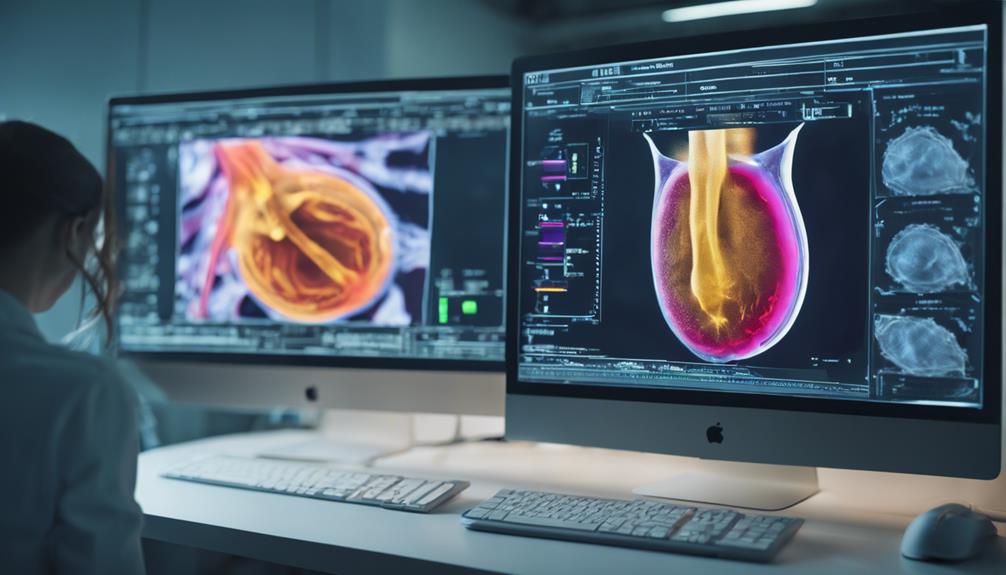
You'll find that managing data with 3D bladder scanners offers various storage options, allowing you to save volumetric images in multiple formats for easy sharing and reference.
The connectivity features of these devices integrate smoothly with EMR systems, streamlining data transfer and access across different healthcare settings.
Additionally, the sophisticated data analysis tools provided enhance the precision of bladder assessments, supporting more informed clinical decisions.
Data Storage Options
3D bladder scanners revolutionize how medical professionals manage and store data, offering advanced features that capture and organize volumetric data and images. Unlike their 2D counterparts, these devices enable you to explore deeply into patient diagnostics with precision and ease.
Here's how your data storage options expand with 3D bladder scanners:
- Built-in Memory: Most 3D scanners come with substantial internal storage, allowing you to save a large volume of volumetric images directly on the device.
- External Storage Compatibility: You've got options like USB ports and SD cards. This flexibility makes it easy to transfer data to other systems or for backup purposes.
- EMR Integration: Directly upload volumetric images and data to electronic medical records. This seamless integration streamlines your workflow, reducing the time you spend on administrative tasks.
- Proprietary Software: Utilize specialized software designed for 3D data management. This software not only helps in organizing and storing data but also enables detailed analysis and manipulation of volumetric images.
With these enhanced data storage options, you can maintain a more efficient, thorough, and accessible record system, improving both patient care and operational efficiency.
Connectivity Features
Advanced connectivity features in 3D bladder scanners, such as USB ports and wireless capabilities, greatly enhance data management. You'll find that these features not only streamline the integration of ultrasound data into electronic medical records (EMR) systems but also facilitate the continuous monitoring of bladder health. This seamless data transfer guarantees that patient records are always up-to-date, improving the accuracy and efficiency of healthcare delivery.
3D scanners support automated volume measurement, considerably reducing manual input errors and simplifying the documentation process. This automation benefits you by allowing more time for patient care rather than data entry. In addition, advanced 3D scanners may offer cloud connectivity, enabling you to access bladder volume data remotely. This feature is particularly beneficial if you need to consult with colleagues or provide patient updates from different locations.
Here's a quick overview of how connectivity features in 3D scanners enhance data management:
| Feature | Benefit | Impact on Care |
|---|---|---|
| USB/Wireless | Seamless EMR integration | Enhances accuracy |
| Automated Volume | Reduces manual input | Increases efficiency |
| Cloud Access | Enables remote consultation and collaboration | Improves flexibility |
| Continuous Monitoring | Tracks bladder health over time | Enhances patient care |
| Data Integration | Streamlines documentation process | Reduces errors |
These connectivity features in 3D scanners are transforming how healthcare professionals manage and utilize data, guaranteeing better patient outcomes and streamlined operations.
Data Analysis Tools
While connectivity features in 3D bladder scanners simplify data integration and patient monitoring, the data analysis tools they employ greatly enhance the precision of bladder volume assessments.
You'll find these tools critical for delivering accurate and reliable data, which is essential in clinical environments where precision is paramount.
Here's how these tools make a difference:
- Advanced Signal Processing: Unlike 2D scanners that offer basic slice views, 3D scanners process complex data to construct detailed volumetric images. This capability allows for a truer representation of the bladder's shape and size.
- Multi-Plane Volume Measurement: By tracing the bladder outline in multiple planes, 3D scanners avoid the common pitfalls of linear dimension-based estimates typical in 2D scans, enhancing the overall accuracy of volume measurements.
- High Correlation Coefficient: With a correlation coefficient of 0.97, 3D scanners demonstrate a high level of precision compared to 2D scanners, which exhibit a lower correlation coefficient of 0.90. This statistical analysis tool guarantees that the measurements are consistently reliable.
- Integration with Statistical Analysis Software: The data from 3D scanners can be seamlessly integrated with sophisticated statistical analysis software, employing techniques like Lin's concordance correlation coefficient to validate the accuracy and agreement of the volume measurements, providing a robust framework for analysis.
Maintenance Requirements
Regarding maintenance, both 2D and 3D bladder scanners demand regular cleaning and disinfection as specified by the manufacturer.
You've got to stick closely to the cleaning protocols provided, especially with 3D scanners, as they contain more complex components that need careful handling.
Make certain you're using the right cleaning agents and methods to avoid damaging these sensitive parts.
When it comes to calibration needs, your 3D scanner will require more frequent check-ups to guarantee its advanced imaging technology continues to deliver accurate volumetric measurements.
You'll need to schedule these check-ups more often than with your 2D scanner, which can generally maintain accuracy with less frequent calibration.
Don't forget the importance of professional servicing.
While you might handle basic upkeep of a 2D scanner yourself, the 3D models often necessitate the expertise of authorized personnel.
This is essential not only to resolve complex issues but also to prevent them.
Those intricate parts and sophisticated software updates mean you're better off with a pro who's up to speed on the latest in 3D scanning tech.
Regular inspections for wear and damage also play a significant role in extending the life of your equipment and guaranteeing consistent performance.
Cost Analysis

When considering the economic impact of choosing between 3D and 2D bladder scanners, it's essential to weigh both the initial and long-term costs.
Let's break down the financial implications involved:
- Upfront Costs: You'll find that 3D bladder scanners typically range from $10,000 to $30,000, whereas 2D scanners are generally more affordable, costing between $5,000 and $15,000. The higher upfront cost of 3D scanners reflects their advanced imaging capabilities.
- Operational Costs: Although 3D scanners are pricier initially, they may lead to lower operational costs over time. Their precision in measurements can decrease the need for repeat scans and further diagnostic procedures, which not only saves money but also enhances overall cost-effectiveness.
- Maintenance and Calibration: The complexity of 3D technology necessitates specialized maintenance, potentially increasing these expenses. However, the reduction in operational costs could offset these higher maintenance fees.
- Insurance Reimbursement: Procedures using 3D scanners often receive higher insurance reimbursement rates due to their improved diagnostic accuracy. This aspect can greatly influence the cost-effectiveness of investing in a 3D scanner, making it a potentially more lucrative option for healthcare facilities.
Future Developments
Exploring the horizon of 3D bladder scanning technology, future advancements are set to markedly enhance diagnostic precision, especially for patients with atypical bladder shapes. You'll see 3D methods improving how accurately bladder volume is estimated. This isn't just about getting numbers right; it's about tailoring care to your specific needs, guaranteeing you receive the most accurate diagnosis possible.
The push for innovation doesn't stop there. Imagine portable 3D bladder scanners becoming a common tool not just in hospitals but in outpatient care and even at home. This shift promises to revolutionize how and where care is delivered, making it more accessible and less of a hassle for you.
Moreover, developers are working on making these devices smarter and easier to use. The interfaces of these scanners are being refined to guarantee that anyone, regardless of their tech skills, can operate them effectively in clinical settings.
Real-time imaging capabilities are also on the drawing board, which would allow for dynamic assessments of bladder function—providing continuous updates and better monitoring of your condition.
All these innovations point to a future where managing bladder health is less invasive, more precise, and tailored just for you.
How Does a Portable Diagnostic Ultrasound Differ from a 3D Bladder Scanner?
A portable diagnostic ultrasound uses sound waves to create images of the body’s internal organs, including the bladder. In contrast, a 3D bladder scanner is a specific tool used to measure bladder volume and urinary retention. While both can be used for bladder evaluation, a portable diagnostic ultrasound offers a wider range of imaging capabilities.
Frequently Asked Questions
What Is the Difference Between a 2D Scan and a 3D Scan?
You're comparing 2D accuracy with 3D visualization in scanning technology, right?
Here's the gist: a 2D scan shows you flat, single-plane images, which are precise but limited in scope.
Meanwhile, a 3D scan compiles multiple 2D images to create a complete, volumetric view, offering greater detail and a better understanding of shapes and sizes.
Although both are useful, 3D technology provides a more thorough analysis but usually at a higher cost.
What Is the Difference Between 2D and 3D Ultrasound Machine?
You're comparing 2D and 3D ultrasound machines, aren't you?
Well, 3D ultrasound technology offers you enhanced imaging accuracy by creating volumetric reconstructions from multiple angles. This means you'll see a more precise depiction of structures, which can greatly improve diagnostic benefits, especially in complex cases.
While 2D ultrasound gives you quicker, simpler images, the depth and clarity in 3D imaging can make a big difference in understanding and treatment planning.
Is a Bladder Scanner the Same as an Ultrasound?
No, a bladder scanner isn't the same as a general ultrasound.
Bladder scanners are specialized devices using ultrasound technology specifically for measuring bladder volume with high accuracy.
They're tailored to focus solely on bladder measurement, making them different from broader-range ultrasound machines that visualize various body parts.
How to Bladder Scan Obese Patients?
To bladder scan obese patients effectively, you'll face obesity challenges that impact imaging accuracy.
Start by positioning your patient either supine or slightly elevated to get a clearer view of the bladder.
Use a high-frequency transducer and apply enough ultrasound gel to guarantee good acoustic contact.
Be patient and thorough, as finding the bladder can be trickier due to larger abdominal circumference and potential organ displacement.
Conclusion
To sum up, you'll find that a 3D bladder scanner offers you remarkably better accuracy than its 2D counterpart. It captures thorough volumetric images, giving you a clearer view and more precise measurements for diagnostic and treatment processes. While it may be less portable and costlier than the 2D model, the enhanced diagnostic capabilities and improved patient outcomes make it a valuable investment. As technology advances, expect even more sophisticated and user-friendly updates to these indispensable medical tools.
